
Research Focus: Incretin Receptor Pharmacology • GIP / GLP-1 Signaling • Metabolic Research
Compound Class: Dual GIP / GLP-1 Receptor Agonist
Mechanism of Action
Tirzepatide is a synthetic 39-amino-acid peptide that functions as a dual agonist at the glucose-dependent insulinotropic polypeptide receptor (GIPR) and the glucagon-like peptide-1 receptor (GLP-1R).
Its primary sequence is based on the native GIP peptide, modified to confer activity at GLP-1R in addition to GIPR. A C20 fatty diacid moiety is conjugated to the peptide backbone, promoting albumin binding and substantially extending the molecule’s circulating half-life relative to native incretin hormones.
Both target receptors are class B G protein-coupled receptors that signal predominantly through Gs proteins. Receptor occupancy activates adenylyl cyclase, elevating intracellular cyclic AMP (cAMP) and engaging downstream protein kinase A (PKA) and Epac-dependent signaling.
A feature of tirzepatide that has attracted particular attention in receptor pharmacology is its signaling profile at GLP-1R. Published research indicates that tirzepatide produces relatively greater cAMP generation compared with beta-arrestin recruitment and receptor internalization at GLP-1R – a pattern described in the literature as biased agonism.
This makes tirzepatide a useful experimental tool for investigating how the balance between G protein-dependent and beta-arrestin-dependent signaling influences receptor behaviour, desensitization, and downstream cellular response.
At GIPR, tirzepatide behaves as a full agonist with an affinity comparable to native GIP.
Product Overview
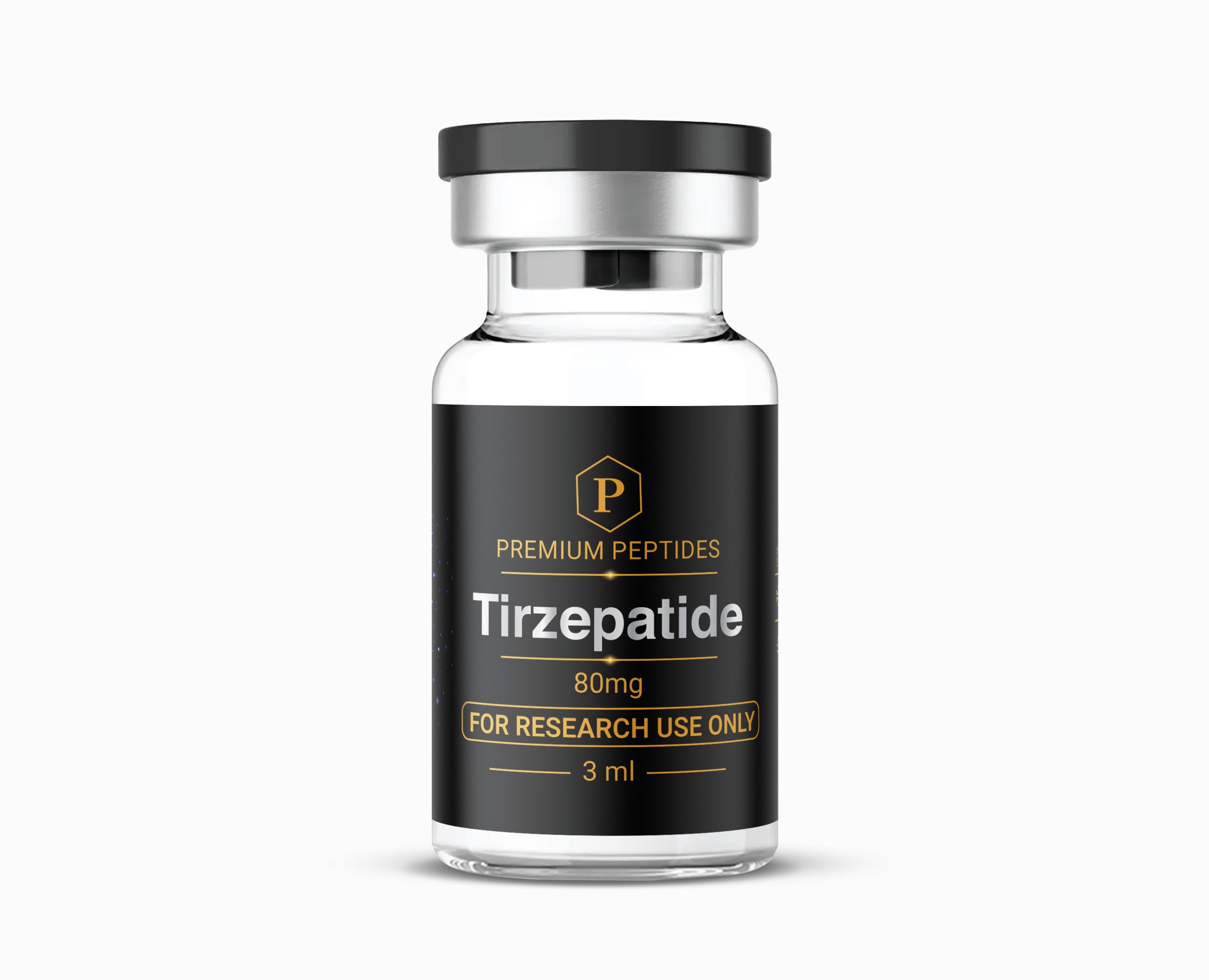
Tirzepatide 80 mg is a synthetic dual incretin receptor agonist supplied as a research compound.
GIP and GLP-1 are the two principal incretin hormones. Both are released from intestinal enteroendocrine cells in response to nutrient intake and act on pancreatic islet cells as part of the entero-insular axis. Native forms of both peptides are rapidly inactivated by dipeptidyl peptidase-4 (DPP-4), which limits their duration of activity.
Tirzepatide was engineered to activate both receptor systems from a single molecular scaffold while resisting enzymatic degradation, producing a pharmacological profile distinct from selective GLP-1 receptor agonists.
The molecule has been extensively characterized in receptor pharmacology research and is a well-defined tool compound for comparative incretin studies.
Primary Biological Targets & Pathways
- Glucose-dependent insulinotropic polypeptide receptor (GIPR)
- Glucagon-like peptide-1 receptor (GLP-1R)
- Class B G protein-coupled receptors
- Gs protein signaling
- Adenylyl cyclase
- Cyclic AMP (cAMP)
- Protein kinase A (PKA)
- Epac signaling
- Beta-arrestin recruitment
- Receptor internalization and desensitization
- Pancreatic islet cell signaling
- Adipose tissue GIPR signaling
- Entero-insular axis
- DPP-4 substrate biology
Primary Research Applications
Tirzepatide has been investigated in research involving:
- Incretin receptor pharmacology
- Dual receptor agonist design
- GIP receptor signaling
- GLP-1 receptor signaling
- Biased agonism and signaling bias
- Beta-arrestin recruitment assays
- Receptor internalization and trafficking
- GPCR structure-activity relationships
- Peptide half-life extension and albumin binding
- Comparative incretin pharmacology
- Metabolic signaling research
- Adipose tissue receptor biology
Scientific Evidence
Evidence Level: ★★★★★ (5 of 5)
Tirzepatide has a substantially stronger evidence base than most compounds categorized as research peptides.
Its receptor pharmacology has been characterized through published binding, signaling, and structure-activity studies, and the molecule has been evaluated through large controlled clinical programmes. Tirzepatide is the active pharmaceutical ingredient in prescription products approved by the U.S. Food and Drug Administration for specific medical indications.
This provides robust evidence regarding the pharmacology of the molecule itself.
That evidence must be interpreted carefully, however. Regulatory approval of a pharmaceutical product containing tirzepatide does not mean that independently manufactured research-grade tirzepatide is an approved drug, nor does it establish the identity, purity, potency, or quality of any research-grade material. These are distinct questions, and the distinction is material.
Research Highlights
Published research has established that tirzepatide:
- Functions as a dual agonist at GIPR and GLP-1R.
- Is a 39-amino-acid peptide based on the native GIP sequence.
- Carries a C20 fatty diacid moiety that promotes albumin binding and extends half-life.
- Activates Gs-coupled, cAMP-dependent signaling at both receptors.
- Demonstrates a signaling profile at GLP-1R favouring cAMP generation over beta-arrestin recruitment.
- Resists degradation by dipeptidyl peptidase-4.
- Provides an experimental model for investigating signaling bias at class B GPCRs.
- Has been characterized through extensive controlled clinical investigation.
- Is the active ingredient of pharmaceutical products approved for specific indications.
Scientific Background
The incretin effect – the greater insulin response produced by oral compared with intravenous glucose – is mediated principally by GIP and GLP-1.
Pharmacological development in this field initially concentrated on GLP-1 receptor agonism, and GIPR received comparatively less attention. Later research established that GIPR activation produces effects distinct from GLP-1R activation, particularly in adipose tissue, and that combined activation of both receptors yields a signaling profile that neither produces alone.
Tirzepatide provided the first well-characterized single-molecule tool for studying that combined activation, and it has consequently become a reference compound in comparative incretin pharmacology.
Its biased signaling profile at GLP-1R is a separate area of interest. G protein-coupled receptors can activate both G protein-dependent and beta-arrestin-dependent pathways, and ligands that favour one over the other are valuable experimental probes for dissecting the functional consequences of each pathway.
Research Use Disclaimer
For Laboratory Research Use Only.
This product is intended exclusively for scientific, analytical, and laboratory research. Information presented describes the molecular pharmacology of tirzepatide and findings reported in scientific literature, and should not be interpreted as instructions for administration or as expected outcomes in individuals.
Although tirzepatide is the active ingredient in FDA-approved prescription pharmaceutical products for specific indications, this research product is not represented as any such approved pharmaceutical product. It is not intended for human consumption, therapeutic administration, diagnosis, treatment, cure, or prevention of disease.
References
- U.S. Food and Drug Administration. Prescribing and regulatory information for tirzepatide-containing products.
- Coskun T, et al. LY3298176, a novel dual GIP and GLP-1 receptor agonist: from discovery to clinical proof of concept.
- Willard FS, et al. Research characterizing tirzepatide receptor signaling and biased agonism at GLP-1R.
- Peer-reviewed literature examining GIP receptor pharmacology and adipose tissue signaling.
- Published research on class B GPCR signaling bias and beta-arrestin recruitment.



Reviews
There are no reviews yet.