
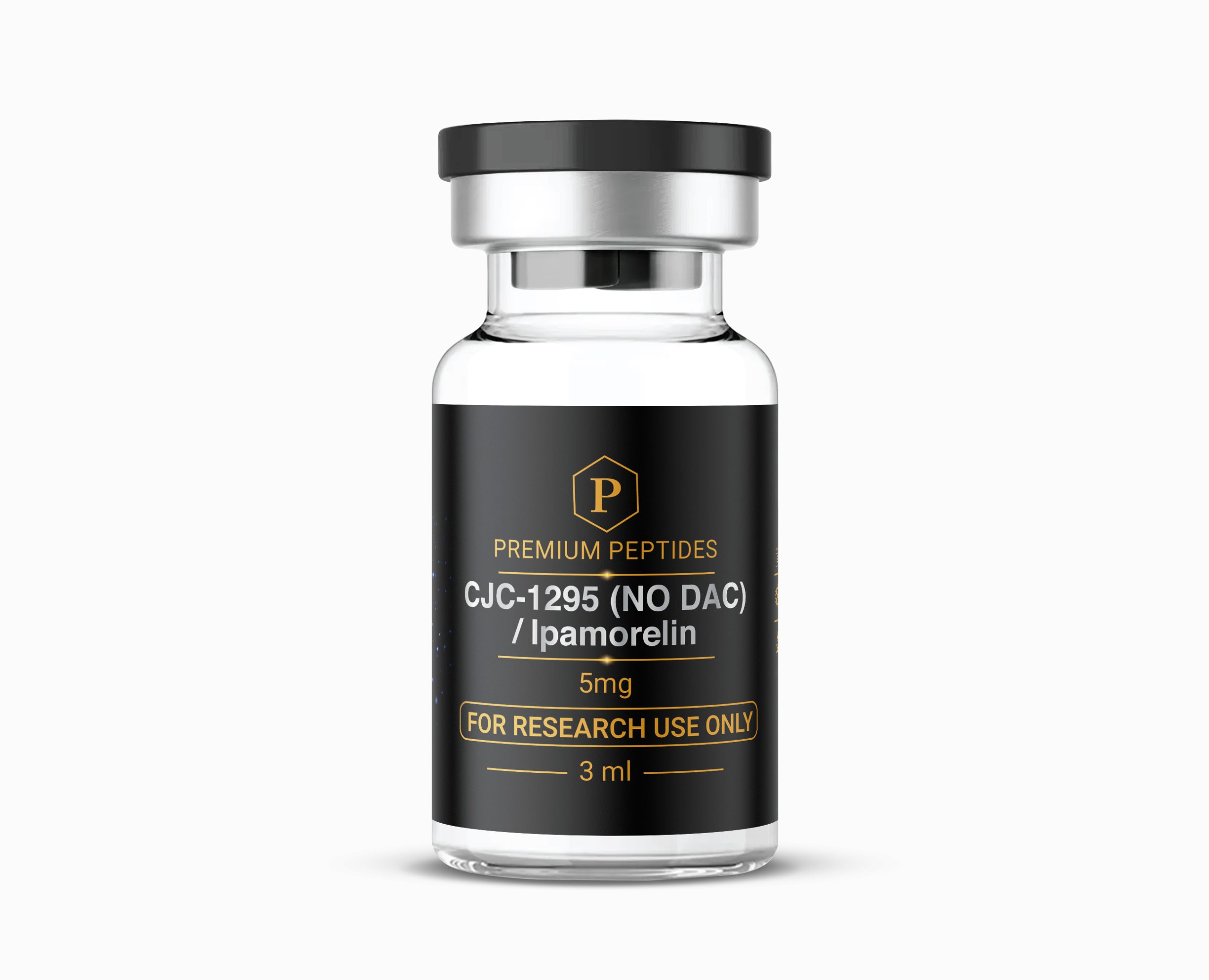
Research Focus: GHRH Signaling • Ghrelin Receptor Pharmacology • Growth Hormone Axis
Compound Class: Dual-Pathway Growth Hormone Secretagogue Research Blend
Mechanism of Action
This research blend combines two peptides that act on the growth hormone axis through separate and complementary receptor systems.
CJC-1295 (without DAC)
CJC-1295 without DAC – also described in the literature as modified GRF(1-29) – is a synthetic analog of the first 29 amino acids of growth hormone-releasing hormone (GHRH). GHRH(1-29) retains the biological activity of the full 44-amino-acid hormone.
The analog incorporates four amino acid substitutions relative to native GHRH(1-29). These modifications are intended to confer resistance to enzymatic degradation, particularly by dipeptidyl peptidase-4, which rapidly inactivates native GHRH.
CJC-1295 acts as an agonist at the growth hormone-releasing hormone receptor (GHRH-R), a class B G protein-coupled receptor expressed on pituitary somatotroph cells. Receptor activation stimulates Gs proteins, increasing adenylyl cyclase activity and intracellular cyclic AMP, with downstream protein kinase A signaling regulating growth hormone synthesis and release.
Ipamorelin
Ipamorelin is a synthetic pentapeptide that acts as an agonist at the growth hormone secretagogue receptor type 1a (GHSR-1a) – the receptor for the endogenous peptide ghrelin.
GHSR-1a is a class A G protein-coupled receptor that couples principally to Gq proteins. Receptor activation stimulates phospholipase C, generating inositol trisphosphate and diacylglycerol, mobilizing intracellular calcium and engaging protein kinase C signaling.
Ipamorelin is notable in the research literature for its receptor selectivity. Compared with earlier growth hormone secretagogues, it has been reported to produce minimal concurrent release of adrenocorticotropic hormone, cortisol, and prolactin, making it a comparatively clean pharmacological probe for GHSR-1a-mediated signaling.
Combined pathway
Because GHRH-R signals through Gs / cAMP and GHSR-1a signals through Gq / calcium, the two peptides engage distinct second-messenger systems within the same cell population. This blend therefore provides an experimental model for investigating how two independent signaling pathways converge on somatotroph regulation.
Product Overview
CJC-1295 / Ipamorelin 10 mg is a research blend pairing a GHRH receptor agonist with a ghrelin receptor agonist.
Growth hormone secretion from the anterior pituitary is regulated by several inputs: GHRH provides the principal stimulatory signal, somatostatin provides tonic inhibition, and ghrelin acting at GHSR-1a provides an additional stimulatory input through a separate receptor and second-messenger pathway.
Research compounds targeting these pathways are commonly studied individually. Blending a GHRH analog with a GHSR-1a agonist allows both stimulatory arms of the axis to be examined together, which is the principal research rationale for this combination.
Neither component is an approved therapeutic agent.
Primary Biological Targets & Pathways
- Growth hormone-releasing hormone receptor (GHRH-R)
- Growth hormone secretagogue receptor 1a (GHSR-1a)
- Pituitary somatotroph cells
- Gs protein signaling
- Gq protein signaling
- Adenylyl cyclase
- Cyclic AMP (cAMP)
- Protein kinase A (PKA)
- Phospholipase C
- Inositol trisphosphate (IP3)
- Intracellular calcium mobilization
- Protein kinase C (PKC)
- Growth hormone synthesis and secretion
- GH / IGF-1 endocrine axis
- DPP-4 substrate biology
Primary Research Applications
This blend has been investigated in research involving:
- GHRH receptor pharmacology
- Ghrelin receptor (GHSR-1a) pharmacology
- Growth hormone secretagogue research
- Hypothalamic-pituitary signaling
- Somatotroph cell biology
- Gs and Gq signaling convergence
- Second-messenger pathway interaction
- Receptor selectivity and off-target hormone release
- Peptide stability and DPP-4 resistance
- GH / IGF-1 axis regulation
- Comparative growth hormone secretagogue pharmacology
Scientific Evidence
Evidence Level: ★★☆☆☆ (2 of 5)
The receptor pharmacology of both components is reasonably well characterized at the molecular and cellular level. GHRH-R and GHSR-1a are both well-defined receptors with established signaling mechanisms, and both peptides have documented agonist activity at their respective targets.
The evidence base is considerably weaker beyond that point. Neither CJC-1295 nor Ipamorelin is an approved therapeutic agent. Ipamorelin underwent early clinical investigation that was not carried through to approval. Controlled human data for either compound are limited, and controlled human data for the two administered in combination are absent from the published literature.
Evidence relating to the separate components should not be assumed to describe the blend. Combination pharmacology is not simply additive, and this formulation has not been characterized as a combination in controlled study.
Research Highlights
Published research has reported that:
- CJC-1295 (no DAC) is a modified GHRH(1-29) analog with four amino acid substitutions.
- Those substitutions confer resistance to enzymatic degradation, including by DPP-4.
- CJC-1295 acts as an agonist at GHRH-R, signaling through Gs and cAMP.
- Ipamorelin is a synthetic pentapeptide agonist at GHSR-1a.
- Ipamorelin signals through Gq, phospholipase C, and intracellular calcium mobilization.
- Ipamorelin demonstrates receptor selectivity, with minimal reported concurrent ACTH, cortisol, and prolactin release.
- The two peptides engage distinct second-messenger systems within the same target cell population.
- Neither compound holds regulatory approval as a therapeutic agent.
Scientific Background
Growth hormone release from pituitary somatotrophs is governed by a coordinated neuroendocrine system. GHRH, released from hypothalamic neurons, provides stimulatory input via GHRH-R. Somatostatin provides inhibitory tone. Ghrelin, produced principally in the stomach, provides a further stimulatory input via GHSR-1a.
The discovery that GHSR-1a was a functional receptor with an endogenous ligand distinct from GHRH established that two separate receptor systems contribute to somatotroph regulation. This prompted extensive research into how the two pathways interact.
Because the receptors couple to different G proteins and engage different second messengers, their interaction is a subject of continued mechanistic interest. Research pairing a GHRH analog with a GHSR-1a agonist provides a model system for examining that interaction directly.
Following growth hormone release, peripheral growth hormone receptors – particularly hepatic – activate downstream signaling that includes production of insulin-like growth factor-1, forming a feedback network across hypothalamic, pituitary, and peripheral tissues.
Component Distinction
The two peptides are frequently conflated in non-scientific sources. They are pharmacologically distinct.
CJC-1295 (no DAC)
- Modified GHRH(1-29) analog
- Target receptor: GHRH-R
- Signaling: Gs / adenylyl cyclase / cAMP
- Acts on the GHRH arm of the axis
Ipamorelin
- Synthetic pentapeptide
- Target receptor: GHSR-1a (ghrelin receptor)
- Signaling: Gq / phospholipase C / calcium
- Acts on the ghrelin arm of the axis
CJC-1295 with DAC is a further distinct molecule, incorporating a drug affinity complex moiety that substantially extends half-life. It should not be treated as equivalent to the no-DAC form supplied here.
Research Use Disclaimer
For Laboratory Research Use Only.
This product is intended exclusively for scientific, analytical, and laboratory research. Information presented describes the molecular pharmacology of the component peptides and findings reported in scientific literature, and should not be interpreted as instructions for administration or as expected outcomes in individuals.
Neither CJC-1295 nor Ipamorelin is an FDA-approved therapeutic agent. This product is not intended for human consumption, therapeutic administration, diagnosis, treatment, cure, or prevention of disease.
References
- Raun K, et al. Ipamorelin, the first selective growth hormone secretagogue. European Journal of Endocrinology.
- Teichman SL, et al. Research examining prolonged-acting GHRH analogs and the GH/IGF-1 axis.
- Kojima M, Kangawa K. Research on ghrelin and the growth hormone secretagogue receptor.
- Howard AD, et al. Characterization of the growth hormone secretagogue receptor GHSR-1a.
- Peer-reviewed literature examining GHRH receptor pharmacology, somatotroph signaling, and growth hormone secretagogue structure-activity relationships.

Reviews
There are no reviews yet.