
Research Focus: Extracellular Matrix Biology • Copper Peptide Chemistry • Cell Migration
Compound Class: GHK-Cu / BPC-157 / TB-500 Research Blend
Mechanism of Action
This research blend combines three peptides studied in connective tissue, extracellular matrix, and cell migration research.
GHK-Cu
GHK-Cu is the copper(II) complex of the tripeptide glycyl-L-histidyl-L-lysine, a sequence identified in human plasma and also present within the collagen alpha-2(I) chain.
The tripeptide binds copper(II) with high affinity. This is the defining feature of the molecule: GHK functions as a copper-binding ligand, and much of its documented biological activity is inseparable from copper coordination chemistry.
Copper is an essential cofactor for several enzymes involved in connective tissue biology, most notably lysyl oxidase, which catalyzes the cross-linking of collagen and elastin fibres. Copper availability therefore has direct consequences for extracellular matrix assembly.
Published research has reported that GHK-Cu influences the expression of genes associated with matrix remodelling in fibroblast culture, including collagen and decorin, and affects the balance between matrix metalloproteinases and their tissue inhibitors. It has also been investigated in relation to copper transport and cellular copper handling.
BPC-157
BPC-157 is a synthetic pentadecapeptide corresponding to a partial sequence of a gastric juice protein. No dedicated receptor has been identified. Experimental research has associated it with VEGFR2-Akt-eNOS signaling, with focal adhesion kinase and paxillin signaling, and with the nitric oxide system.
TB-500
TB-500 corresponds to the actin-binding region of thymosin beta-4, the principal G-actin sequestering protein in mammalian cells. By binding monomeric actin, thymosin beta-4 regulates the equilibrium between monomeric and filamentous actin and thereby influences cytoskeletal remodelling and cell motility.
Combined rationale
The three peptides are associated with different aspects of connective tissue and matrix research: GHK-Cu with copper-dependent matrix enzyme chemistry and matrix gene expression, BPC-157 with growth factor receptor and nitric oxide signaling, and TB-500 with cytoskeletal regulation of cell migration. The blend allows these mechanisms to be examined in parallel within a single experimental system.
Product Overview
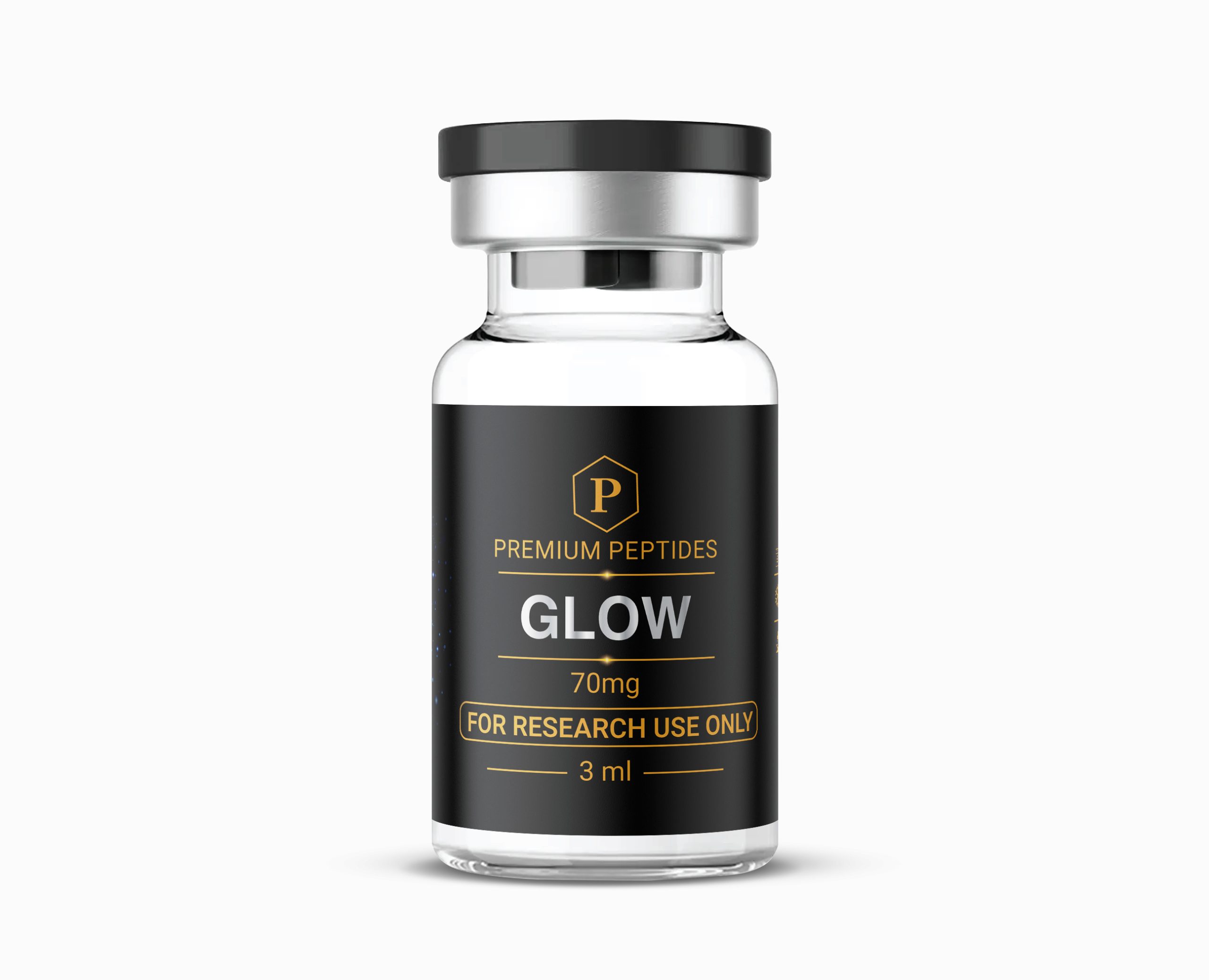
Glow 70 mg is a research blend combining a copper-binding tripeptide with two peptides studied in cell migration and matrix biology.
Extracellular matrix research spans several distinct mechanistic areas: the enzymatic cross-linking chemistry that gives matrix its structural properties, the gene expression programmes that govern matrix protein synthesis, the proteolytic systems that remodel it, and the cell migration processes that operate within it.
This blend’s components map onto different parts of that landscape, which is the research rationale for combining them.
None of the three components is an approved therapeutic agent.
Primary Biological Targets & Pathways
- Copper(II) binding and coordination chemistry
- Lysyl oxidase and copper-dependent enzymes
- Collagen synthesis and cross-linking
- Decorin and proteoglycan expression
- Matrix metalloproteinases (MMPs)
- Tissue inhibitors of metalloproteinases (TIMPs)
- Extracellular matrix remodelling
- Cellular copper transport
- G-actin binding and sequestration
- Actin polymerization dynamics
- Cell migration and motility
- VEGFR2 signaling
- Akt and eNOS signaling
- Focal adhesion kinase (FAK) and paxillin
- Fibroblast biology
Primary Research Applications
The component peptides have been investigated in research involving:
- Extracellular matrix biology
- Copper peptide chemistry
- Collagen and elastin cross-linking
- Matrix metalloproteinase regulation
- Fibroblast gene expression
- Dermal and connective tissue models
- Cell migration assays
- Cytoskeletal dynamics
- Angiogenesis models
- In vitro wound-closure models
- Metal-binding peptide research
- Peptide structure-activity relationships
Scientific Evidence
Evidence Level: ★★☆☆☆ (2 of 5)
The evidence base differs substantially across the three components, and a single rating is necessarily a compromise.
GHK-Cu has the strongest foundation. Its copper coordination chemistry is well characterized, the role of copper in lysyl oxidase and matrix cross-linking is firmly established biochemistry, and there is a body of published fibroblast culture work examining matrix gene expression. Much of this evidence is nonetheless cellular rather than clinical.
BPC-157 evidence derives predominantly from rodent models, with proposed mechanisms that remain provisional in the absence of an identified receptor.
Thymosin beta-4’s actin-sequestering function is well established; evidence for the synthetic TB-500 fragment specifically is thinner.
None of the three components has completed controlled human clinical investigation, and no published research characterizes them in combination. The blend has not been studied as a blend.
Research Highlights
Published research has reported that:
- GHK is a tripeptide sequence identified in human plasma and within collagen alpha-2(I).
- GHK binds copper(II) with high affinity, forming the GHK-Cu complex.
- Copper is an essential cofactor for lysyl oxidase, which cross-links collagen and elastin.
- GHK-Cu influences matrix-associated gene expression in fibroblast culture.
- GHK-Cu has been investigated in relation to MMP and TIMP balance.
- BPC-157 is associated in experimental models with VEGFR2, Akt, and eNOS signaling.
- TB-500 corresponds to the actin-binding region of thymosin beta-4.
- Thymosin beta-4 regulates the G-actin to F-actin equilibrium underlying cell motility.
- Evidence for all three components derives predominantly from cellular and animal models.
Scientific Background
The extracellular matrix is not an inert scaffold. It is a dynamic structure whose composition and mechanical properties are continuously regulated by the cells embedded within it.
Collagen fibrils acquire their tensile strength through covalent cross-links formed by lysyl oxidase, a copper-dependent amine oxidase. Copper availability is therefore a direct biochemical determinant of matrix integrity, which is the principal reason copper-binding peptides are of interest in this field.
Matrix turnover is governed by matrix metalloproteinases and opposed by tissue inhibitors of metalloproteinases. The balance between these two systems determines whether matrix is being deposited or degraded, and it is a standard experimental readout in connective tissue research.
Cell migration operates within and upon this matrix. Fibroblasts and endothelial cells must remodel their cytoskeleton to move, and actin dynamics are central to that process – which is where thymosin beta-4 and its fragments enter the picture.
Research combining copper coordination chemistry, matrix enzyme regulation, and cytoskeletal biology therefore addresses several linked layers of connective tissue function.
Research Use Disclaimer
For Laboratory Research Use Only.
This product is intended exclusively for scientific, analytical, and laboratory research. Information presented describes the reported molecular biology of the component peptides and findings from experimental scientific literature, and should not be interpreted as instructions for administration or as expected outcomes in individuals.
None of the component peptides is an FDA-approved therapeutic agent. This product is not intended for human consumption, therapeutic administration, diagnosis, treatment, cure, or prevention of disease.
References
- Pickart L, Margolina A. Regenerative and protective actions of the GHK-Cu peptide. International Journal of Molecular Sciences.
- Maquart FX, et al. Research examining GHK-Cu and extracellular matrix regulation in fibroblast models.
- Goldstein AL, Hannappel E, Kleinman HK. Thymosin beta-4: actin-sequestering protein moonlights to repair injured tissues. Trends in Molecular Medicine.
- Sikiric P, et al. Preclinical research examining BPC-157 and angiogenesis-associated signaling.
- Peer-reviewed literature examining lysyl oxidase, collagen cross-linking, and MMP/TIMP regulation.

Reviews
There are no reviews yet.