
Research Focus: Cell Migration • Angiogenesis Signaling • Cytoskeletal Biology
Compound Class: BPC-157 / TB-500 Research Blend (10 mg / 10 mg)
Mechanism of Action
This research blend combines two peptides studied for their roles in cell migration, cytoskeletal dynamics, and angiogenesis-associated signaling in experimental models.
BPC-157
BPC-157 is a synthetic pentadecapeptide corresponding to a partial sequence of a protein identified in gastric juice, from which its name – body protection compound – derives.
Unlike receptor-targeted peptides, BPC-157 has no single well-defined receptor. Experimental research has instead associated it with several intracellular signaling systems.
The most frequently reported is the VEGFR2-Akt-eNOS pathway. Cellular studies have described upregulation of vascular endothelial growth factor receptor 2 expression and downstream activation of Akt and endothelial nitric oxide synthase, a cascade extensively characterized in angiogenesis research.
Additional experimental work has reported effects on focal adhesion kinase and paxillin signaling – proteins central to cell adhesion and migration – and interaction with the nitric oxide system more broadly.
Some studies in tendon-derived fibroblasts have reported upregulation of growth hormone receptor expression, providing a proposed link between BPC-157 exposure and growth factor responsiveness in those cell types.
TB-500
TB-500 is a synthetic peptide corresponding to the actin-binding region of thymosin beta-4, a naturally occurring 43-amino-acid peptide. The commonly studied fragment centres on the LKKTETQ sequence.
Thymosin beta-4 is the principal actin-sequestering protein in mammalian cells. It binds monomeric G-actin and regulates the equilibrium between monomeric and filamentous actin, thereby influencing cytoskeletal remodelling, cell shape change, and cell motility.
Because directed cell migration depends on controlled actin polymerization at the leading edge, actin-sequestering peptides are of substantial interest in cell migration and wound-model research. Thymosin beta-4 has additionally been investigated in angiogenesis models.
Combined rationale
The two peptides are associated with overlapping experimental endpoints – cell migration and angiogenesis signaling – but through different proposed mechanisms: BPC-157 through growth factor receptor and nitric oxide signaling, TB-500 through direct actin binding. The blend allows both to be examined in parallel within a single experimental system.
Product Overview
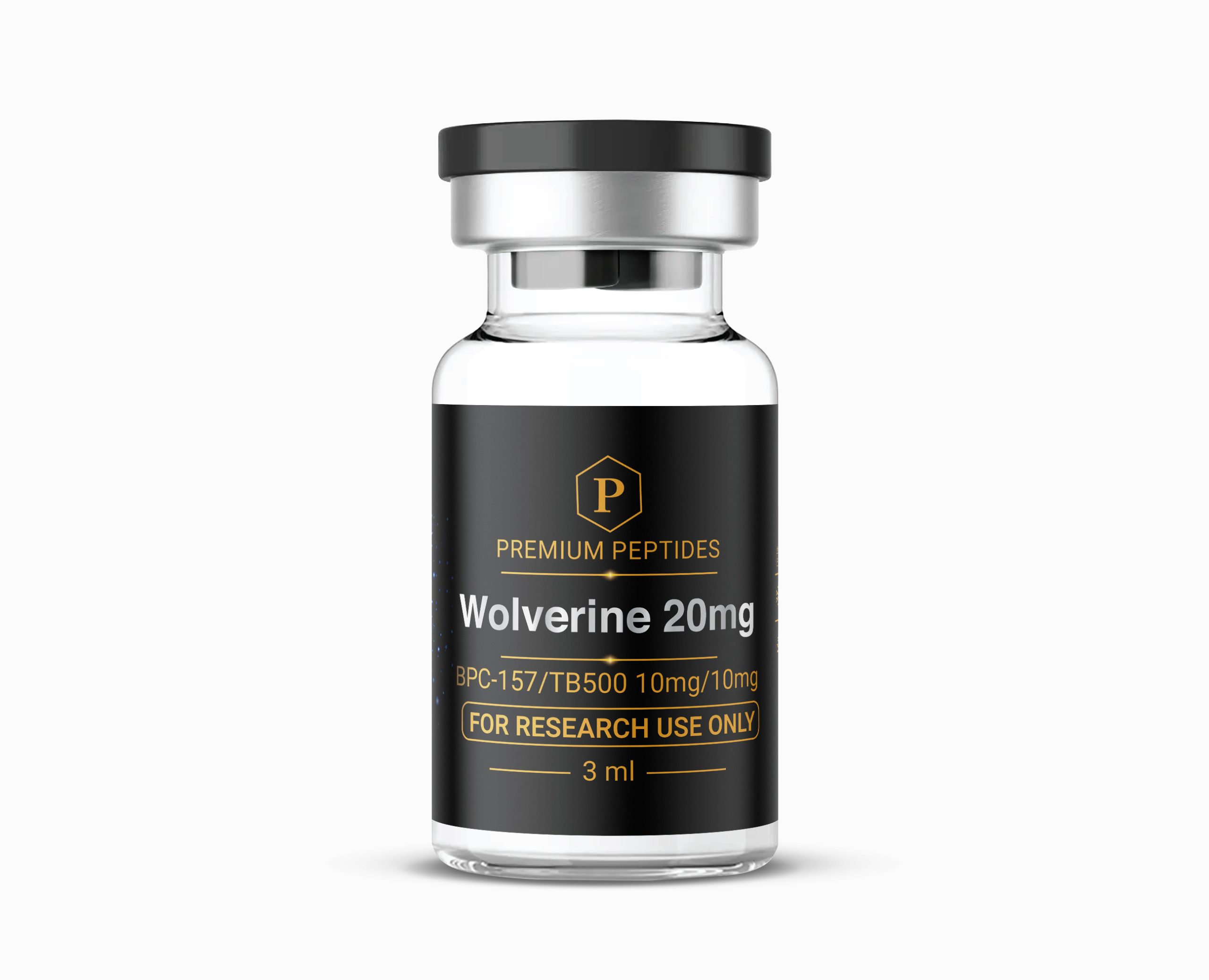
Wolverine 20 mg is a research blend supplying 10 mg BPC-157 and 10 mg TB-500.
Both component peptides are widely used experimental compounds in cell migration, cytoskeletal, and angiogenesis research. Neither is a receptor-selective pharmacological agent in the conventional sense: BPC-157 has no confirmed dedicated receptor, and TB-500 acts through direct protein-protein interaction with actin rather than through a cell-surface receptor.
This distinguishes them mechanistically from the receptor agonists elsewhere in this catalog and should be borne in mind when comparing evidence quality across compound classes.
Neither peptide is an approved therapeutic agent, and neither has been characterized in controlled human clinical study.
Primary Biological Targets & Pathways
- G-actin binding and sequestration
- Actin polymerization dynamics
- Cytoskeletal remodelling
- Cell migration and motility
- VEGFR2 signaling
- Akt signaling
- Endothelial nitric oxide synthase (eNOS)
- Nitric oxide system
- Focal adhesion kinase (FAK)
- Paxillin signaling
- Cell adhesion complexes
- Angiogenesis-associated signaling
- Growth hormone receptor expression (experimental models)
- Fibroblast and endothelial cell biology
Primary Research Applications
The component peptides have been investigated in research involving:
- Cell migration assays
- Cytoskeletal dynamics
- Actin polymerization and sequestration
- Angiogenesis models
- Endothelial cell biology
- Fibroblast biology
- In vitro wound-closure models
- Focal adhesion signaling
- Nitric oxide signaling
- Tissue and matrix biology
- Thymosin beta-4 fragment research
- Peptide structure-activity relationships
Scientific Evidence
Evidence Level: ★★☆☆☆ (2 of 5)
The evidence base for both components is predominantly preclinical.
Thymosin beta-4 itself is a well-characterized endogenous protein with a firmly established role in actin sequestration. That established biochemistry is the strongest part of the evidence here. Evidence relating to the synthetic TB-500 fragment specifically, as distinct from full-length thymosin beta-4, is considerably thinner.
BPC-157 has been studied principally in rodent models, with a smaller body of cellular work. Its proposed mechanisms remain provisional: no dedicated receptor has been identified, and the signaling associations reported in the literature have not been resolved into a confirmed mechanism of action.
Neither peptide has completed controlled human clinical investigation, and neither holds regulatory approval in any jurisdiction. Findings from rodent and cellular models should not be extrapolated to human biology.
No published research characterizes these two peptides in combination. The blend has not been studied as a blend.
Research Highlights
Published research has reported that:
- BPC-157 is a synthetic pentadecapeptide derived from a gastric juice protein sequence.
- No dedicated cell-surface receptor for BPC-157 has been identified.
- Experimental studies associate BPC-157 with VEGFR2, Akt, and eNOS signaling.
- Experimental studies additionally associate BPC-157 with FAK-paxillin signaling and the nitric oxide system.
- TB-500 corresponds to the actin-binding region of thymosin beta-4.
- Thymosin beta-4 is the principal G-actin sequestering protein in mammalian cells.
- Actin sequestration regulates the monomer-filament equilibrium underlying cell motility.
- Thymosin beta-4 has been investigated in angiogenesis and cell migration models.
- Evidence for both peptides derives predominantly from cellular and rodent studies.
Scientific Background
Directed cell migration requires coordinated regulation of the actin cytoskeleton. Actin exists in equilibrium between monomeric G-actin and filamentous F-actin, and the rate of polymerization at the leading edge of a migrating cell determines its capacity to advance.
Thymosin beta-4 maintains a reservoir of sequestered G-actin, making it a central regulator of this equilibrium. Its actin-binding domain has consequently been a focus of peptide research, and synthetic fragments containing that domain are used as experimental probes.
Angiogenesis involves a related set of processes: endothelial cells must migrate, proliferate, and organize into new vascular structures. VEGF signaling through VEGFR2, with downstream Akt and eNOS activation, is among the best-characterized pathways in this field.
Research interest in BPC-157 derives largely from reported activity within this pathway in experimental models. That research should be read with appropriate caution: the reported associations are numerous and mechanistically diverse, which in the absence of an identified receptor makes a unified mechanism difficult to establish.
Research Use Disclaimer
For Laboratory Research Use Only.
This product is intended exclusively for scientific, analytical, and laboratory research. Information presented describes the reported molecular biology of the component peptides and findings from experimental scientific literature, and should not be interpreted as instructions for administration or as expected outcomes in individuals.
Neither BPC-157 nor TB-500 is an FDA-approved therapeutic agent. This product is not intended for human consumption, therapeutic administration, diagnosis, treatment, cure, or prevention of disease.
References
- Goldstein AL, Hannappel E, Kleinman HK. Thymosin beta-4: actin-sequestering protein moonlights to repair injured tissues. Trends in Molecular Medicine.
- Sikiric P, et al. Preclinical research examining BPC-157 and angiogenesis-associated signaling pathways.
- Hsieh MJ, et al. Research examining BPC-157, VEGFR2 signaling, and endothelial models.
- Philp D, Kleinman HK. Research on thymosin beta-4 in cell migration and angiogenesis models.
- Peer-reviewed literature examining actin dynamics, cytoskeletal regulation, and cell migration mechanisms.

Reviews
There are no reviews yet.